
El Niño is one of the most important natural climate events on Earth, known for its wide-reaching effects on weather, ecosystems, and human activities. It is part of a larger system called the El Niño–Southern Oscillation (ENSO), which involves periodic changes in ocean temperatures and atmospheric pressure across the tropical Pacific Ocean.
What is El Niño?
El Niño refers to the abnormal warming of sea surface temperatures in the central and eastern Pacific Ocean, particularly along the equator. The name “El Niño,” meaning “The Little Boy” in Spanish, was first used by fishermen along the coast of Peru because the warming typically appeared around Christmas.
This warming disrupts normal weather patterns and can influence climate conditions across the globe.
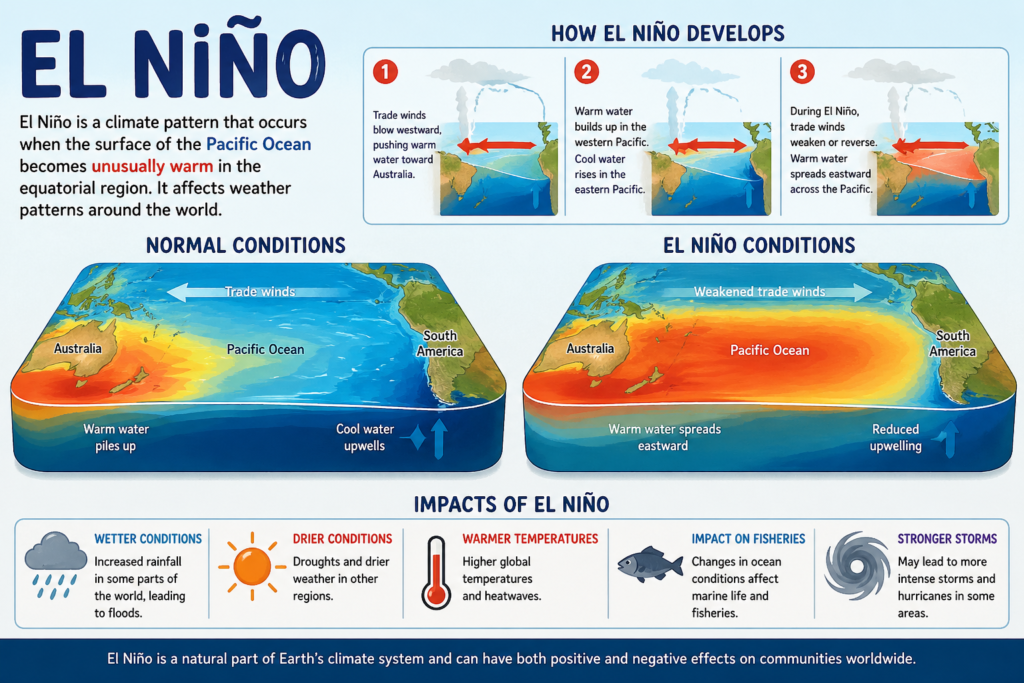
Normal Conditions vs El Niño Conditions
Under normal conditions:
- Trade winds blow from east to west across the Pacific
- Warm water accumulates near Asia and Australia
- Cold, nutrient-rich water rises near the west coast of South America
During El Niño:
- Trade winds weaken or reverse
- Warm water shifts eastward toward South America
- Upwelling of cold water is reduced
These changes disturb the balance between the ocean and atmosphere.
Causes of El Niño
El Niño develops due to complex interactions between the ocean and the atmosphere. Key factors include:
- Weakening of trade winds
- Changes in atmospheric pressure patterns
- Ocean-atmosphere feedback loops
Although scientists understand many aspects of El Niño, predicting its exact timing and intensity remains challenging.
Global Impacts of El Niño
El Niño affects weather patterns worldwide, often causing extreme and unpredictable conditions:
1. South America
Countries like Peru and Ecuador may experience heavy rainfall, floods, and landslides.
2. Asia and Australia
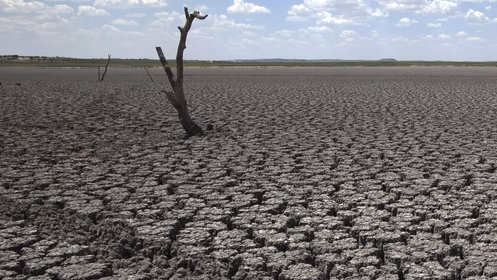
Regions such as India and Australia often face droughts, weak monsoons, and increased risk of wildfires.
3. North America
Some areas see warmer winters, while others experience heavier rainfall and storms.
4. Africa
Different regions may face either droughts or flooding depending on how weather systems shift.
Impact on Marine Life
El Niño has serious effects on ocean ecosystems. The reduction in cold water upwelling decreases nutrients in the ocean, leading to:
- Decline in fish populations
- Disruption of food chains
- Economic losses for fishing industries
This is especially significant along the coasts of South America, where fishing is a major livelihood.
El Niño vs La Niña
El Niño is often compared with its opposite phase, La Niña.
- El Niño: Warmer ocean temperatures, weaker winds
- La Niña: Cooler ocean temperatures, stronger winds
While El Niño tends to increase global temperatures, La Niña can bring cooler and wetter conditions in many regions.
Why El Niño is Important
El Niño plays a crucial role in global climate variability. Its impacts include:
- Changes in agricultural productivity
- Water shortages or flooding
- Increased risk of natural disasters
- Effects on economies and livelihoods
Governments and scientists monitor El Niño closely to prepare for these potential impacts and reduce damage.
Conclusion
El Niño is a powerful example of how interconnected Earth’s systems are. A change in ocean temperature in one region can influence weather across the entire planet. By studying El Niño and improving forecasting methods, scientists aim to better predict its effects and help societies adapt to its challenges.
In simple terms, El Niño is not just a warming of ocean water—it is a global climate event that shapes weather, ecosystems, and human life in profound ways.