
Entertainment


El Niño and Its Impact on Global Weather Patterns
El Niño is one of the most important natural climate events on Earth, known for its wide-reaching effects on weather, ecosystems, and human activities. It is part of a larger system called the El Niño–Southern Oscillation (ENSO), which involves periodic changes in ocean temperatures and atmospheric pressure across the tropical Pacific Ocean.
What is El Niño?
El Niño refers to the abnormal warming of sea surface temperatures in the central and eastern Pacific Ocean, particularly along the equator. The name “El Niño,” meaning “The Little Boy” in Spanish, was first used by fishermen along the coast of Peru because the warming typically appeared around Christmas.
This warming disrupts normal weather patterns and can influence climate conditions across the globe.
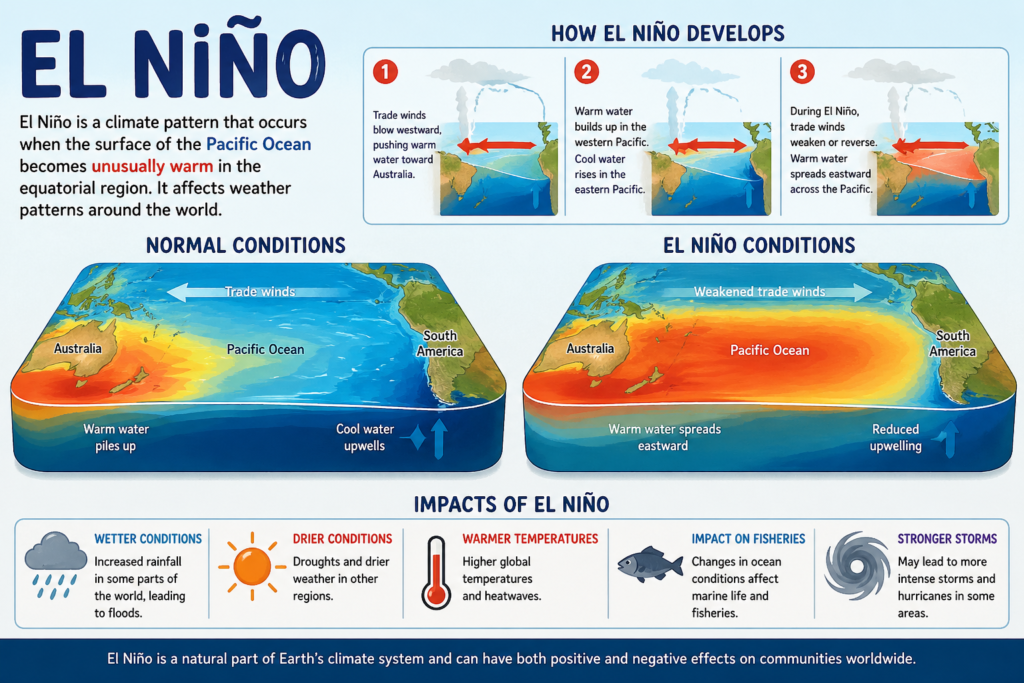
Normal Conditions vs El Niño Conditions
Under normal conditions:
- Trade winds blow from east to west across the Pacific
- Warm water accumulates near Asia and Australia
- Cold, nutrient-rich water rises near the west coast of South America
During El Niño:
- Trade winds weaken or reverse
- Warm water shifts eastward toward South America
- Upwelling of cold water is reduced
These changes disturb the balance between the ocean and atmosphere.
Causes of El Niño
El Niño develops due to complex interactions between the ocean and the atmosphere. Key factors include:
- Weakening of trade winds
- Changes in atmospheric pressure patterns
- Ocean-atmosphere feedback loops
Although scientists understand many aspects of El Niño, predicting its exact timing and intensity remains challenging.
Global Impacts of El Niño
El Niño affects weather patterns worldwide, often causing extreme and unpredictable conditions:
1. South America
Countries like Peru and Ecuador may experience heavy rainfall, floods, and landslides.
2. Asia and Australia
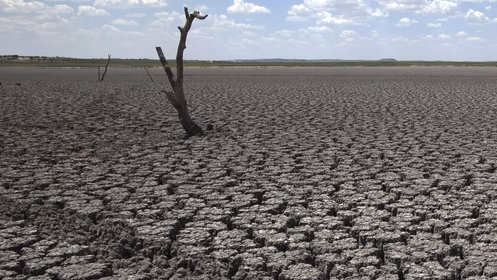
Regions such as India and Australia often face droughts, weak monsoons, and increased risk of wildfires.
3. North America
Some areas see warmer winters, while others experience heavier rainfall and storms.
4. Africa
Different regions may face either droughts or flooding depending on how weather systems shift.
Impact on Marine Life
El Niño has serious effects on ocean ecosystems. The reduction in cold water upwelling decreases nutrients in the ocean, leading to:
- Decline in fish populations
- Disruption of food chains
- Economic losses for fishing industries
This is especially significant along the coasts of South America, where fishing is a major livelihood.
El Niño vs La Niña
El Niño is often compared with its opposite phase, La Niña.
- El Niño: Warmer ocean temperatures, weaker winds
- La Niña: Cooler ocean temperatures, stronger winds
While El Niño tends to increase global temperatures, La Niña can bring cooler and wetter conditions in many regions.
Why El Niño is Important
El Niño plays a crucial role in global climate variability. Its impacts include:
- Changes in agricultural productivity
- Water shortages or flooding
- Increased risk of natural disasters
- Effects on economies and livelihoods
Governments and scientists monitor El Niño closely to prepare for these potential impacts and reduce damage.
Conclusion
El Niño is a powerful example of how interconnected Earth’s systems are. A change in ocean temperature in one region can influence weather across the entire planet. By studying El Niño and improving forecasting methods, scientists aim to better predict its effects and help societies adapt to its challenges.
In simple terms, El Niño is not just a warming of ocean water—it is a global climate event that shapes weather, ecosystems, and human life in profound ways.


The Last Tree: A Warning Rooted in Silence
The Last Tree: A Warning Rooted in Silence
What happens when the final leaf falls, and the forest no longer echoes with the sound of life?
In a world shaped by rapid industrialization, relentless consumption, and environmental negligence, the idea of “the last tree” no longer feels like distant science fiction—it feels like a prophetic vision. As forests vanish at an alarming rate and climate change accelerates, we are forced to confront the chilling possibility of a future without trees.
The Silent Collapse
Trees have long been more than just part of the landscape. They are the lungs of our planet, absorbing carbon dioxide, releasing oxygen, sheltering wildlife, and anchoring ecosystems that sustain life itself. Yet, according to the Food and Agriculture Organization (FAO), we lose approximately 10 million hectares of forest every year—roughly the size of Portugal.
The “last tree” serves as a powerful symbol of ecological collapse. It is the imagined sentinel left standing after bulldozers, chainsaws, and wildfires have claimed the rest. It represents the end of biodiversity, the silencing of birdsong, and the absence of shade on scorched earth. But more than anything, it is a mirror reflecting our failure to value what sustains us.

A Lesson from Easter Island
History offers a sobering lesson through the story of Easter Island. Once covered in lush palm forests, the island was deforested by its inhabitants to the point of collapse. When the last tree was cut, it marked the beginning of the end for their civilization. Jared Diamond, author of Collapse, called it “ecocide”—the self-inflicted destruction of an environment that made survival impossible.
Easter Island is not unique. It is a cautionary tale repeated across continents and centuries. The Amazon, the Congo Basin, and Southeast Asia are today’s frontlines of a battle between economic growth and environmental preservation.
If the Last Tree Could Speak
If the last tree stood today, what would it say? Perhaps nothing. Its silence would say enough.
But perhaps we should speak for it—louder than ever. Its metaphor compels us to act, to plant, to protect, and to protest. It challenges us to rethink our relationship with nature, from one of domination to one of stewardship.
Hope Is Still Rooted
The good news? The last tree is not yet standing. There are still forests to protect, saplings to plant, and ecosystems to restore. Reforestation projects, indigenous-led conservation efforts, and global climate movements offer a lifeline. But time is not infinite.
Let the idea of the last tree be our wake-up call—not our epitaph. Because once the last tree is gone, there are no more warnings. Only consequences.
What Can We Do Now?
The good news is that the last tree hasn’t died yet. Reforestation efforts, sustainable practices, and environmental activism are still making a difference. Governments, communities, and individuals are waking up — but the window for action is narrowing.
If we want to avoid the fate of a world without trees, we must act boldly:
- Plant and protect trees in urban and rural areas.
- Support indigenous communities who are often the most effective forest guardians.
- Push for policies that curb deforestation and promote sustainability.
- Educate others on the true cost of environmental neglect.